Types of LED Lights and where to use them
LED Lights
Sep 21, 2026
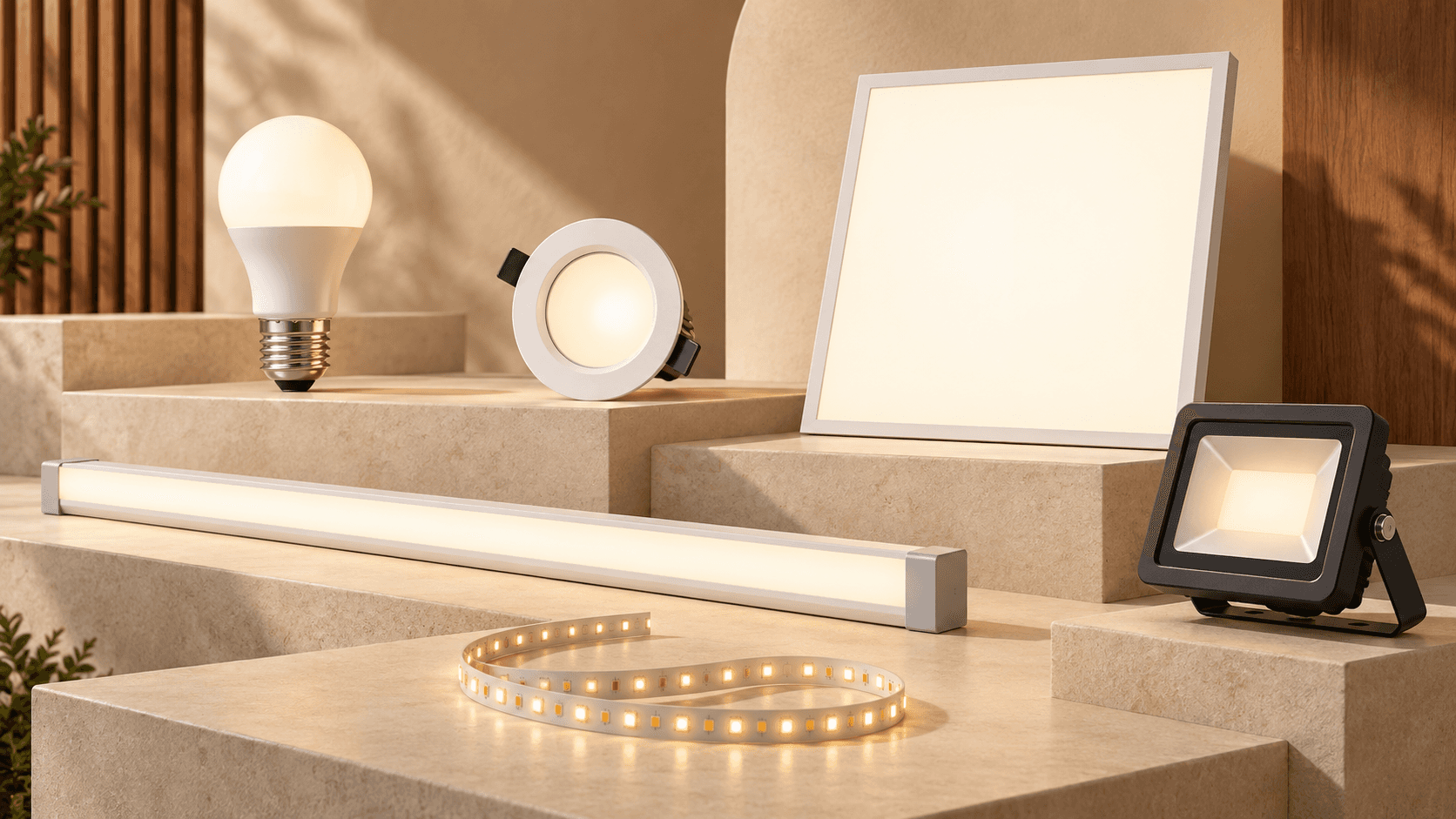
The main types of LED lights include bulbs, downlights, panels, tubes, strips, spotlights and flood lights. Bulbs suit lamps and existing holders, downlights give ceilings a neat finish, panels and tubes provide general light, strips and spotlights add task or accent lighting, and flood lights cover outdoor areas.
That sounds simple enough, but one room can need more than one type. A living room, for example, may work best with downlights for general light, a floor lamp with an LED light bulb for reading, and a spotlight for artwork. Good lighting is usually a small team, not one very bright fitting trying to do everything.
What are the main types of LED lights?
LED type
What it does best
Good places to use it
Check before buying
LED bulb
Flexible, replaceable general or decorative light
Table lamps, pendants, wall lights, bedrooms and living rooms
Cap type, physical size, lumens and enclosed-fixture suitability
LED downlight
Creates tidy, directed pools of light from the ceiling
Living rooms, hallways, kitchens, shops and reception areas
Recessed or surface mounting, cut-out size, beam and glare
LED panel light
Spreads soft-looking light across a broad area
Offices, classrooms, clinics, shops and modern home interiors
Ceiling type, mounting method, dimensions and driver access
LED tube or batten
Provides practical linear light
Kitchens, garages, workshops, stores, classrooms and offices
Whether it is an integrated batten or a tube retrofit
LED strip light
Adds discreet task light or ambience
Under cabinets, shelves, wardrobes, coves and display joinery
Driver, channel, heat management and moisture rating
LED spotlight or track light
Draws attention to a smaller area or object
Artwork, retail displays, textured walls and work surfaces
Beam spread, aim, glare and colour rendering
LED flood light
Covers a wide outdoor area
Compounds, driveways, façades, loading areas and sports spaces
Outdoor rating, mounting, glare control and sensor compatibility
LED high-bay light
Lights large interiors with high ceilings
Warehouses, factories, hangars and large workshops
Mounting height, layout, output and professional lighting design
What job should your lighting perform?
Before comparing products, decide what the light needs to do.
Ambient lighting is the general light that lets you move around comfortably. Panels, tubes, bulbs and a planned layout of downlights can all provide it.
Task lighting helps with a specific activity, such as food preparation, reading, grooming or detailed work. Under-cabinet strips, desk lamps and carefully aimed spotlights are common choices.
Accent lighting adds visual focus. It can bring out artwork, a textured wall, shelving or architectural details. Spotlights, track lights and strips are useful here.
Outdoor area lighting helps people see routes, entrances and open spaces. Flood lights, wall lights and pathway fittings must suit the actual exposure to rain, dust and contact.
This distinction matters because brightness alone cannot fix a poor layout. A kitchen may feel bright overall and still cast a shadow exactly where you chop vegetables. A bedroom may have enough light to clean the room but feel too harsh when you are winding down. The right LED type puts light where it is useful.
LED light bulbs are the flexible, replaceable option
An LED light bulb is the simplest choice when you already have a suitable lamp holder or decorative fitting. It works well in table lamps, pendants, wall sconces, floor lamps and many ceiling fixtures. Bulbs are also convenient to replace without changing the entire fitting.
Use them when you want flexibility. A warm bulb can make a bedside lamp feel relaxed, while a brighter neutral-white bulb may suit a utility area. Decorative globe, candle and filament-style bulbs can be visible parts of the design, provided their brightness and glare suit the space.
Check the cap or base type, the bulb's physical dimensions and whether it is approved for an enclosed fitting. Enclosed shades can trap heat, so check the product instructions before choosing a bulb for one. If a dimmer is fitted, confirm that the bulb works with it.
LED downlights give ceilings a clean, structured look
An LED downlight directs light downward from a compact ceiling fitting. Recessed versions sit inside a ceiling opening, while surface-mounted versions attach below the ceiling where recessing is not practical.
Downlights suit hallways, living rooms, kitchens, hotel rooms, reception areas and shops. They can provide general light when planned across a room, or more focused light over circulation routes and work zones.
The neat appearance comes with a little homework. A recessed fitting needs the correct ceiling opening and the clearances specified by its manufacturer. Where it has a separate driver, the power-supply unit for the LEDs, plan access for maintenance. Beam spread and spacing matter too: narrow beams placed too far apart can leave bright circles with gloomy gaps between them.
For wider coverage, compare a broad-beam downlight with a diffused panel or pendant. The number of fittings you need depends on their output, light distribution, mounting height and the room layout. A pendant's shape alone will not tell you how far its light spreads.
LED panel lights are made for broad, even-looking illumination
An LED panel light uses a flat, diffused surface to spread light across a wider area. Large rectangular panels are common in offices, classrooms, clinics and commercial interiors. Smaller round or square panels also appear in homes, corridors and retail spaces.
Panels make sense where visual simplicity and broad coverage matter. They can reduce the patchy effect that comes from using a few narrow-beam fittings as the only source of general light. They are especially useful over open-plan work areas, counters and rooms with a clean, modern ceiling design.
Check whether the model is recessed, surface-mounted or suspended, and whether its mounting kit suits your ceiling. Ask whether the light source or driver can be replaced separately if either fails.
LED tube lights and battens suit practical work areas
LED tube lights provide light along a long, narrow fitting and are often used in kitchens, workshops, garages, stores, classrooms and offices. Integrated LED battens serve a similar purpose, but the light source and fitting come as one unit rather than as a separate tube inside an older fitting.
They are worth considering over a workbench or along an aisle. Check how the light falls across the working area: length alone does not guarantee even coverage, and placement matters just as much.
Before replacing a fluorescent tube, have an electrician check the existing ballast, the component that controls the tube's electrical supply. Compatibility depends on the specific tube and ballast: manufacturers such as LEDVANCE publish tested compatibility lists. Follow the instructions for the exact product, and leave any wiring changes to the electrician.
LED strip lights work best when they stay discreet
LED strips are flexible boards fitted with many small light sources. They can sit under kitchen cabinets, inside wardrobes, below shelves, around ceiling coves or behind display joinery.
Their sweet spot is discreet task or accent lighting. A well-positioned strip under an upper kitchen cabinet can light the worktop without your body casting a shadow. In a living room, a concealed strip can give shelving or a ceiling detail a gentle glow.
For a softer look, consider a strip installed in a channel with a diffuser, a cover that spreads the light. View a sample before committing, especially if you want to hide the individual dots. Ask the supplier to match the strip, power supply and mounting accessories, and follow the manufacturer's installation instructions.
LED spotlights and track lights add focus
Spotlights send light towards a smaller target. Fixed or adjustable spotlights can highlight artwork, wall textures, shelves or architectural features. Track systems make it easier to aim several lights independently, which is useful in galleries, shops, showrooms and changing displays.
Spotlighting needs restraint. If the beam lands directly in people's eyes or creates sharp reflections on a television, polished tile or glass display, the effect becomes tiring rather than dramatic. Aim the light at the subject, and test the view from normal sitting and standing positions.
LED flood lights are for wide outdoor coverage
LED flood lights spread light across compounds, driveways, building façades, loading areas and other open spaces. They can also work with motion or daylight controls when the fixture and control system are compatible.
Choose them for coverage, not because "brighter" automatically means "safer". A badly aimed flood light can create glare, deep shadows and unwanted light in a neighbour's window. Position and aiming are part of the design.
Outdoor fittings also need an enclosure suitable for their exposure. The IP code defined in IEC 60529 classifies protection against access, solid objects and water. The required rating depends on whether the fitting is under a canopy, on an exposed wall, close to ground splash or in another demanding position. Check the product documentation and have the installation assessed properly.
LED high-bay lights belong in tall, large interiors
High-bay lights are designed for large spaces with high mounting points, such as warehouses, factories, hangars and some sports or workshop buildings. They deliver a great deal of light from above and are not a sensible substitute for an ordinary room fitting.
For these projects, ask a lighting professional for a plan showing where each fitting goes and the expected light levels across the working area. The plan should account for ceiling height, shelving, machinery and the tasks people perform.
Smart LED lights change control, not the basic lighting job
Smart bulbs and fixtures may offer app control, scheduling, dimming, tunable white light or colour effects. Those features can be useful in bedrooms, living rooms, hospitality spaces and meeting rooms.
But "smart" is a control feature, not a new lighting purpose. A smart bulb still needs the correct base and brightness. A smart downlight still needs the right beam, cut-out and ceiling conditions. Check whether it relies on Wi-Fi, Bluetooth, a hub or a particular automation platform, and decide what should happen after a power cut or internet interruption.
How do you choose the right type of LED light?
Once the fixture format is clear, compare these details.
Look at lumens for brightness and watts for power use
Lumens describe light output; watts describe electrical input. Two LED products with the same wattage do not necessarily produce the same useful amount or distribution of light. The US Department of Energy's buyer guidance recommends comparing lumens when judging brightness.
Room size matters, but so do wall colours, ceiling height, daylight, fixture position and the activity in the space. For a full room or commercial project, a lighting calculation is more reliable than a generic "one bulb per room" rule.
Pick a colour temperature that suits the activity
Correlated colour temperature, measured in kelvin (K), describes whether white light looks warmer and more yellow or cooler and more blue-white.
Around 2700 K to 3000 K usually gives a warm appearance suited to bedrooms, living rooms, dining areas and relaxed hospitality spaces.
Around 3500 K to 4100 K gives a more neutral or clean-looking white often used in offices, kitchens, reception areas and shops.
Higher daylight-like settings can suit workshops, garages or detail-focused tasks, but they may feel stark in a room meant for relaxing.
These are design starting points, not strict room laws. If several fittings are visible together, keep their colour appearance consistent unless the contrast is intentional.
Check colour rendering where finishes and skin tones matter
Colour rendering describes how a light source affects the appearance of colours. The US Department of Energy recommends a colour rendering index (CRI) of at least 80 for general interior lighting. If you're choosing lights for a clothing display, makeup mirror or artwork, pay particular attention to how colours look under them.
CRI is useful, but it is not the whole story. If colour accuracy matters to a project, review the full product data and, where possible, test a sample against the actual materials.
Match beam and diffusion to the effect you want
A narrow or controlled beam helps with accents and specific tasks. A broad or diffused distribution works better for general coverage. The fixture's optics, height and aim influence the result as much as the LED source itself.
Think about glare as well. A fitting can look attractive in a catalogue and still feel uncomfortable if the bright light source is visible from a sofa, desk or shop counter.
Use the right protection for bathrooms and outdoor areas
Tell the installer exactly where the light will sit, especially near a shower, above a worktop or on an exposed wall. Ask them to confirm that its IP rating and installation instructions suit that position and the current applicable Nigerian requirements. A general description such as "bathroom light" or "waterproof" is not enough to make that decision.
Check dimming, controls and power compatibility
Not every LED product is dimmable, and not every dimmable LED works well with every dimmer. Drivers, sensors, automation controls and emergency or backup systems must be compatible too.
If the lights will run from grid power, a generator, an inverter or a solar-backed system, give the electrician or system designer the product's actual electrical specifications and the number of fittings. In places where supply conditions vary, ask what appropriate protection is needed rather than relying on an unverified "surge-proof" label.
How can you combine different LED lights in one room?
These examples show how different fittings can work together. Treat them as starting points for your own layout.
A living room that doubles as a reading space

Imagine a sofa facing a television, with an armchair by a bookshelf. Use ceiling lights for moving around and a lamp beside the armchair for reading. A spotlight can pick out the bookshelf, if you want that detail. Put the groups on separate controls so an evening with a book doesn't require every ceiling light to be on.
A kitchen with cabinets above the worktop
A ceiling panel or batten can provide general light, but check the worktop while standing where you normally prepare food. If your body blocks the ceiling light, an under-cabinet strip may help. Try its position before the installation is finished, and check for reflections from glossy tiles or counters.
A shop where the displays change
Use panels or linear fittings for general light, then adjustable track lights for featured products. When a display moves, check the aim again. View a few actual products under a sample light before choosing the fittings, particularly if customers need to compare fabric or paint colours.
The best LED type is the one that fits the space
There is no single best LED for every room. The useful question is: what must this light do, and what conditions must it handle?
Choose the format first, then compare lumens, colour temperature, colour rendering, beam, mounting, protection and control compatibility. For permanent fittings or a full-room layout, involve a suitably qualified professional. Nigeria's electricity safety agency, NEMSA, certifies electrical contractors and promotes safe installation standards.
Ready to narrow the options? Explore Volga's lighting range and contact the Volga Nigeria team for current specifications and availability for your home, workplace or project.